A Step-by-Step Playbook for Building a Safer, More Connected Community
There’s an old proverb that says, “It takes a village to raise a child.” In the 21st century, it also takes a village to secure a home. In an era where many of us feel more isolated from our neighbors than ever before, we often overlook our single greatest security asset: each other. Criminals thrive on anonymity and exploit the disconnectedness of modern communities, knowing that a street where neighbors are strangers is a street where no one is watching.
The most powerful antidote to this is the Neighborhood Watch. Far from the outdated stereotype of curtain-twitching busybodies, a modern Neighborhood Watch is an organized, tech-enabled, and highly effective community partnership. It’s a formal program designed to unite neighbors, create a culture of mutual awareness, and build a direct, collaborative relationship with local law enforcement. It is, without a doubt, the most cost-effective “security system” you can implement.
This definitive guide will serve as your step-by-step playbook for launching, running, and revitalizing a successful Neighborhood Watch program. We will cover everything from the initial recruitment and law enforcement partnership to the art of effective observation, the use of modern communication tools, and how to navigate the common challenges that can arise.
What is a Modern Neighborhood Watch? Debunking the Myths
Before you begin, it’s crucial to understand what a Neighborhood Watch is—and what it is not.
What It IS
- An Observation and Reporting Program: The core function of a member is to be an alert, observant neighbor who knows how to effectively report suspicious activity.
- A Communication Network: It provides a structured way for neighbors to share information with each other and with law enforcement quickly and accurately.
- A Partnership with Law Enforcement: A legitimate Neighborhood Watch is formally recognized and supported by the local police or sheriff’s department.
- A Community-Building Initiative: At its heart, the program is about turning a collection of houses into a connected, resilient community.
What It is NOT
- A Group of Vigilantes: This is the most important distinction. Members never, under any circumstances, intervene in a crime or directly confront suspicious individuals. Their role is strictly to observe and report from a safe distance.
- A Replacement for the Police: A Neighborhood Watch is a partner to law enforcement, not a substitute. All emergencies and crimes in progress must be reported by calling 911 immediately.
- A Tool for Profiling or Harassment: A successful program focuses on specific, suspicious behaviors, not on the identity or appearance of individuals. Fair and impartial observation is paramount.
The Step-by-Step Playbook for Launching Your Neighborhood Watch
Starting a program from scratch can seem daunting, but it’s a manageable process when broken down into clear steps.
Step 1: Gauge Interest and Recruit a Core Team
You don’t need the whole neighborhood on board at first. Start small. Talk to two or three motivated neighbors who share your concerns and are willing to help with the initial organizational work. This core team will be the foundation of the program.
Step 2: Contact Your Local Law Enforcement Agency
This is a non-negotiable step that formalizes your group. Call your local police or sheriff’s department’s non-emergency line and ask to speak with the officer in charge of Community Relations or Crime Prevention. Inform them that you are interested in starting an official Neighborhood Watch. They will be your most valuable partner, providing you with:
- Official training on what to look for and how to report crime.
- Resources, materials, and official signage.
- Crime statistics and trend data for your specific area.
- A direct liaison to the department.
Step 3: Define Your Neighborhood’s Boundaries
Work with your core team to define a specific, manageable geographic area for your group. A good rule of thumb is between 20 and 50 homes. It should be an area where neighbors are likely to have a clear line of sight to each other’s properties.
Step 4: Hold Your First Official Meeting
Publicize the meeting with flyers and door-to-door conversations. The goal is to introduce the program and get buy-in from the wider community. Your agenda should include:
- Introductions and a statement of purpose.
- A presentation by your law enforcement liaison officer. This is the most important part of the meeting, as it lends official credibility to the program.
- A vote to formally establish the watch and to elect a Block Captain and a co-captain.
- Gathering contact information from all interested members.
- Deciding on a primary communication method.
Step 5: Establish Your Communication Network
Rapid, reliable communication is the lifeblood of an effective watch.
- Modern Tools:
- WhatsApp or a Group Text: Excellent for instant, urgent alerts.
- A Private Facebook Group or Nextdoor Group: Great for less urgent announcements, sharing meeting minutes, and posting general safety tips.
- The Neighbors App by Ring: A powerful, map-based social network for neighborhoods.
- The Old-School Failsafe: Maintain a simple email list and phone tree for those who are not on social media. Inclusivity is key.
Step 6: Get the Official Signs and Materials
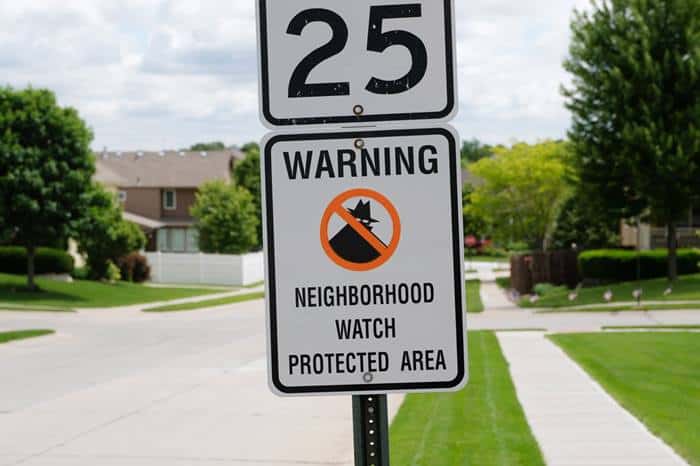
Work with your law enforcement partner to obtain and post official “Neighborhood Watch” signs at the entrances to your designated area. These signs are a powerful psychological deterrent, immediately signaling to potential criminals that the residents are organized, vigilant, and in communication with the police.
The Art of Observation: How to Be an Effective Witness
The core skill of a Neighborhood Watch member is effective observation and reporting.
Recognizing “Suspicious” vs. “Unusual” Activity
Your goal is to focus on objective behaviors that deviate from the normal baseline of your neighborhood.
- Suspicious Examples: A person walking into a neighbor’s backyard when you know they are at work; someone going from door to door trying handles; a vehicle circling the block multiple times, slowly; someone carrying property (like a TV) out of a house at an odd hour.
- Unusual but Not Necessarily Suspicious: A new delivery service, a car you don’t recognize parked on the street, a person walking down the street. It’s about context.
The Reporting Protocol: What to Do and Who to Call
- When to Call 911: For any emergency or crime in progress. This includes seeing someone breaking into a home, hearing screams, seeing a fire, or any immediate threat to life or property.
- When to Call the Non-Emergency Line: For reporting suspicious activity that is not an immediate emergency, such as a strange vehicle that has been parked for a long time or to provide a tip about past criminal activity.
- How to Report Effectively: Provide calm, objective facts.
- For vehicles, use the CYMBALS acronym: Color, Year, Make, Body style, And License, State.
- For people, give a top-to-bottom description: race, gender, approximate age, height, weight, hair color, and a detailed description of clothing (hat, shirt, pants, shoes). Note any distinguishing features like glasses, facial hair, or tattoos.
Beyond Crime: The Expanded Role of a Modern Neighborhood Watch
A truly successful program evolves beyond just crime prevention and becomes a hub for community resilience.
- Natural Disaster Preparedness: The group’s communication network is invaluable during a hurricane, wildfire, or severe storm. It can be used to share official evacuation orders, check on vulnerable neighbors who may need help, and report downed power lines or other hazards.
- Community Well-being: A Neighborhood Watch fosters a sense of community that can be leveraged for positive activities, like organizing a block party, a community clean-up day, or simply checking in on elderly or isolated neighbors during a heatwave.
Sustaining Momentum: How to Keep Your Group Active and Engaged
The biggest challenge for any Neighborhood Watch is apathy. Here’s how to combat it.
- Regular, Purposeful Meetings: Hold meetings quarterly, not just to rehash old business, but with a purpose. Invite a guest speaker—a firefighter to talk about fire safety, a cybersecurity expert to talk about online scams.
- The Block Captain as a Facilitator: The leader’s job is to keep communication flowing and delegate tasks, not to do everything themselves.
- Celebrate and Share Small Wins: Did the group’s communication help find a lost pet? Did a member’s report about a suspicious vehicle lead to an arrest? Share these successes to show the group’s value.
- Welcome New Neighbors: Make it a formal part of your process to have a member greet new residents, give them a welcome packet with community information, and personally invite them to join the watch.
Navigating the Common Challenges and Pitfalls
- The Risk of Vigilantism: Constantly reinforce the “Observe and Report” mantra. Your charter should explicitly forbid members from ever confronting or pursuing a suspect.
- The Dangers of Profiling and Bias: This is a critical risk that must be actively managed. Work with your police liaison to provide formal training on fair and impartial observation. The focus must always be on specific, concrete, and suspicious behaviors, not on a person’s race, age, or style of dress.
- Dealing with “Digital Drama”: Group chats and Facebook pages can sometimes devolve into gossip or arguments. The Block Captain must act as a firm but fair moderator, enforcing a clear code of conduct that keeps the conversation focused on safety and community information.
Frequently Asked Questions (FAQ) about Neighborhood Watch Programs
1. Do Neighborhood Watch programs actually work to reduce crime? Yes. Numerous studies, including a comprehensive review by the U.S. Department of Justice, have concluded that active, well-organized Neighborhood Watch programs are associated with a significant reduction in crime.
2. How much time does it take to be a member? It takes no extra time at all. Membership is not about actively patrolling; it’s about being observant and aware during your normal daily routines—walking your dog, getting the mail, driving to and from work.
3. Am I legally liable if something happens on my “watch”? No. You are acting as a private citizen and a witness. Your only legal and moral responsibility is to report potential criminal activity to the police from a safe distance. You are not assuming any law enforcement role or liability.
4. Can renters join a Neighborhood Watch program? Absolutely. Renters are a vital part of the community fabric. Their participation is crucial for the success of any program, especially in neighborhoods with a mix of single-family homes and apartment buildings.
5. Do I need any special equipment to be a member? The only equipment you need are your eyes, your ears, and a phone.
The Final Verdict: More Than Security, It’s Community
A Neighborhood Watch is the single most cost-effective and powerful “security system” you can implement. It multiplies the eyes and ears on your street by an order of magnitude, replacing the anonymity that criminals rely on with a powerful culture of awareness and mutual support. It is a formal partnership with law enforcement, built on the simple but powerful principle of “observe and report.”
Ultimately, starting or joining a Neighborhood Watch is about more than just fighting crime; it’s an investment in the health and vitality of your community. It is about forging connections with the people you live alongside, building a foundation of trust, and actively creating the kind of safe, secure, and friendly neighborhood where everyone wants to live.
Learn more about Security Systems
