From FEMA Standards and Ballistic Protection to Construction Costs and Essential Supplies
In a world of uncertainty, the concept of a safe room offers the ultimate in home protection—a dedicated space within your own home, meticulously engineered to withstand the unthinkable and provide a sanctuary in a moment of crisis. It represents the final and most formidable layer in any home security strategy, a place of near-absolute protection for you and your family.
However, the terms “safe room,” “panic room,” and “storm shelter” are often used interchangeably, leading to dangerous confusion. A room designed to stop a bullet is not necessarily engineered to withstand an F5 tornado, and vice-versa. The decision to build a safe room is a significant financial and structural investment, and it demands a clear-eyed understanding of your primary threats and the rigorous standards required to defeat them.
This definitive guide will cut through the ambiguity. We will explore the critical differences between a panic room built for home invasion and a storm shelter built for natural disasters. We will provide a deeply researched dive into the construction methods, the official FEMA and ballistic standards you must demand, the crucial components of life-support and communication, and a realistic breakdown of the costs involved, helping you determine if this ultimate security feature is the right investment for your home.
Defining the Mission: Panic Room vs. Storm Shelter – What’s Your Primary Threat?
Before you can design a solution, you must first define the problem. The construction, location, and features of your safe room will be dictated entirely by the primary threat you are trying to mitigate.
The Panic Room: Protection Against Human Threats
A panic room is an internally-secured space designed to provide immediate, short-term protection from human threats like a home invasion, burglary, or targeted attack.
- Primary Purpose: To create an impenetrable hideout where your family can safely retreat, lock themselves in, and call for help. The goal is to outlast the threat until law enforcement arrives.
- Design Focus: The priorities are forced-entry resistance and ballistic protection. The door is the most critical component, followed by the reinforcement of the surrounding walls. The room is often designed to be concealed.
- Key Features: A heavy-gauge steel door that swings outward, a multi-point locking system, concealed hinges, no windows, and a dedicated, secure line of communication to the outside world.
The Storm Shelter: Protection Against Natural Disasters
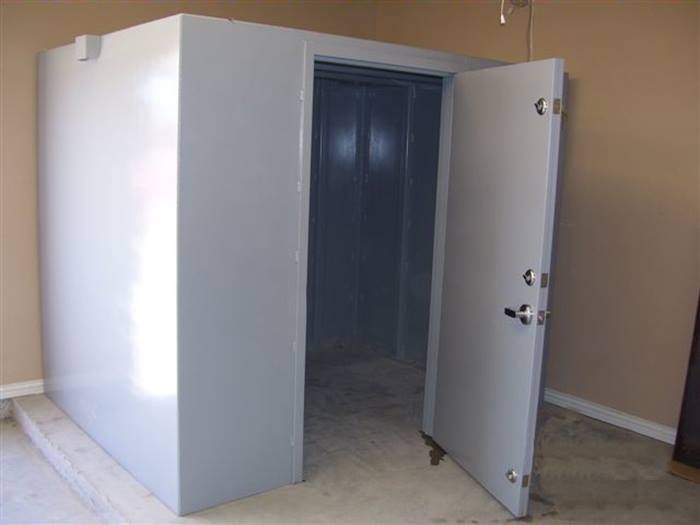
A storm shelter is an engineered structure designed to protect its occupants from the extreme forces of nature, specifically the high winds and flying debris associated with tornadoes and hurricanes.
- Primary Purpose: To provide a space that will remain structurally intact and protect you from injury during a catastrophic weather event.
- Design Focus: The priorities are resisting extreme wind pressures, impact from wind-borne debris, and structural collapse. The entire structure—walls, ceiling, and door—must work as a single, monolithic unit.
- Key Features: Reinforced concrete or welded steel construction, a door that has been impact-tested, secure ventilation that prevents debris intrusion, and strict adherence to official engineering standards.
The Hybrid Safe Room: A Multi-Threat Solution
It is possible to build a single room that serves both purposes, but this requires meticulous planning. This typically involves building a FEMA-compliant storm shelter and then adding ballistic protection (like Kevlar or steel liners) to the interior. This is the most comprehensive—and most expensive—option.
The Anatomy of a Safe Room: A Deep Dive into Construction and Materials
A safe room is an engineered system. The following components must be designed to work in concert to provide real protection.
Walls and Ceiling: The Protective Shell
- Reinforced Concrete: The gold standard for storm shelters. This can be either poured-in-place concrete with a web of steel rebar, or Concrete Masonry Units (CMUs, or cinder blocks) with every core filled with concrete and rebar.
- Steel Panels: Many prefabricated storm shelters and panic rooms are constructed from heavy-gauge, welded steel panels. The thickness of the steel (its gauge) is critical—a lower gauge number means thicker steel.
- Ballistic Panels: For retrofitting an existing closet into a panic room, panels made of Kevlar, aramids, or hardened steel can be layered inside the existing drywall to provide various levels of ballistic resistance.
The Door and Lock: The Most Critical Component
The door is the most complex and most frequently attacked part of any safe room.
- The Door: A security door must be made of reinforced steel and fit into an equally strong steel frame. For maximum security, it should swing outward. This prevents an attacker from being able to use a battering ram to break the lock and force the door inward.
- The Lock: A standard residential deadbolt is completely inadequate. A safe room door should have a high-security lock that can only be locked and unlocked from the inside. This prevents anyone from accidentally or maliciously locking you in. Look for vault-style, multi-point locking systems that drive multiple steel bolts into the frame at the top, bottom, and side.
Ventilation, Power, and Communications
- Secure Ventilation: A safe room must be airtight to be secure, but this requires a mechanical ventilation system. For storm shelters, these vents must be engineered with baffles to allow air to pass through but block flying debris.
- Air Filtration: For the highest level of protection, bunkers and high-end panic rooms can be equipped with CBRN (Chemical, Biological, Radiological, Nuclear) air filtration systems.
- Backup Power: The room should have a dedicated battery backup system (like a UPS) to power lights, communication, and ventilation in the event of a power outage.
- Communication Lines: You cannot rely on a cell phone signal inside a concrete and steel box. A safe room must have a dedicated and protected communication line, such as a hardwired landline phone (which operates independently of your internet service) or, for the highest level of assurance, a satellite phone.
Understanding the Standards: FEMA P-361 and Ballistic Ratings
Do not invest in a safe room from a company that cannot provide proof of independent, third-party certification to these standards.
FEMA P-361: The Gold Standard for Storm Shelters
This is not a law, but a set of rigorous design and construction guidelines published by the Federal Emergency Management Agency (FEMA) for building a residential shelter that provides “near-absolute protection” from extreme weather.
- Key Requirements: A FEMA P-361 compliant shelter must be structurally able to withstand winds of 250 mph (the equivalent of an EF-5 tornado) and resist the impact of a 15-pound 2×4 timber traveling at 100 mph. The door, ventilation, and anchoring systems must all pass these brutal impact tests.
Ballistic Protection Levels (UL 752)
Underwriters Laboratories (UL) provides the industry standard for testing bullet-resistant materials. The levels are rated from 1 to 8.
- UL 752 Level 3: This is a common and practical standard for residential panic rooms. Materials rated to this level can withstand multiple shots from a .44 Magnum handgun.
- UL 752 Level 8: This is a much higher security standard, often used for government buildings. It requires the material to stop multiple shots from a 7.62mm assault rifle (like an AK-47).
Stocking Your Safe Room: The Essential Emergency Supplies
Your safe room should be stocked and ready at all times. The goal is to have everything you need to survive comfortably for a minimum of 72 hours.
- Safety & First Aid: A comprehensive trauma and first aid kit, a fire extinguisher, N95 dust masks, work gloves, and hearing protection.
- Communication: A fully charged power bank for your cell phone, a hand-crank emergency radio (NOAA weather band is essential), and a loud whistle.
- Sustenance: At least one gallon of bottled water per person, per day. A three-day supply of non-perishable, high-energy food that requires no cooking (e.g., energy bars, dried fruit, peanut butter).
- Tools & Sanitation: A crowbar (to pry debris if needed), a multi-tool, a 5-gallon bucket with a toilet seat lid, heavy-duty trash bags, zip ties, and personal hygiene supplies.
- Personal Items: A 7-day supply of any prescription medications, a spare pair of glasses, and comfort items for children like books or a small toy.
The Cost Factor: A Realistic Look at the Investment
A safe room is a major construction project with a price tag to match.
- Prefabricated Steel Tornado Shelters: A small, 4-6 person above-ground or in-garage shelter that is FEMA P-361 compliant typically costs between $6,000 and $15,000, installed.
- Retrofitting a Closet into a Panic Room: Reinforcing the walls of an existing closet (6’x6′) with ballistic steel or Kevlar panels and installing a high-security door assembly can range from $15,000 to $30,000+, depending on the ballistic level.
- Custom-Built Reinforced Concrete Safe Room: Integrating a new, poured-concrete safe room into a new home build or as a home addition is the most expensive option, often starting at $50,000 and easily exceeding $100,000 for a fully outfitted, multi-threat room.
Frequently Asked Questions (FAQ) about Safe Rooms
1. Can I build a safe room myself? For a simple panic room retrofit focusing on forced entry, a skilled DIYer might be able to reinforce a closet. However, for any room intended to provide life-safety protection from a tornado or ballistic threats, professional design and construction is non-negotiable. These are engineered systems that must be built to exacting standards to function correctly.
2. Will a safe room increase my home’s value? Yes. In areas prone to tornadoes or hurricanes, a FEMA-compliant storm shelter is a significant selling feature and can add to your property’s appraisal value. A high-end panic room is a luxury feature that will appeal to security-conscious buyers.
3. How long should I plan to be in a safe room? For a home invasion, the duration is typically short—from minutes to a few hours, until law enforcement arrives. For a natural disaster or its aftermath, you should be prepared to shelter in the room for a minimum of 72 hours.
4. What’s the difference between a safe room and a bunker? A bunker is typically an underground structure designed for long-term (weeks or months), self-sufficient survival, often including features like independent power generation, water wells, and extensive food storage. A safe room is designed for short-term survival of an immediate threat.
5. Do I need a building permit to install a safe room? Almost always, yes. Whether it’s a prefabricated shelter being anchored in your garage or a custom-built room, this is a structural addition to your home that will require a building permit and inspections from your local municipality.
The Final Verdict: Is a Safe Room the Right Investment for You?
A safe room is the ultimate expression of home security and family protection. It is a significant investment, and the decision to build one should be driven by a clear-eyed assessment of your most probable threats.
If you are building this fortress, your mission is to do it right. First, define your primary objective: protection from people or protection from nature? Second, demand independent, third-party certification to the appropriate standard, whether it’s FEMA P-361 for storms or a UL 752 rating for ballistic threats. Finally, and most importantly, hire a qualified, experienced, and reputable contractor to build and install it. A safe room is not a feature to cut corners on. When built correctly, it is more than a room; it is a profound source of peace of mind, a physical guarantee that you have provided the highest level of protection possible for your family.
Learn more about Security Systems
